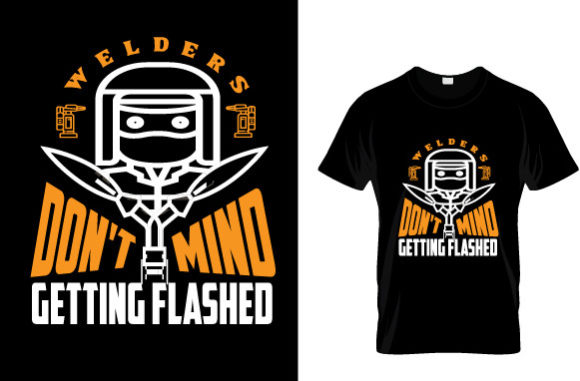
Welder Don’t Mind Getting Flashed Graphics & T-Shirt Designs
As a handmade business designer who’s shipped over 12,000 custom items—from Cricut-cut vinyl mugs to sublimated tumblers and Etsy-printable planner kits—I opened Welder Don’t Mind Getting Flashed with one question: “Can I trust this in my next batch?” Not just for fun, but for real orders—wedding party favors for a welder’s sister, Father’s Day bundles for a local craft fair, and seasonal Etsy listings that need to convert fast.
First impression? It lands with bold, friendly confidence—not aggressive, not ironic, but warmly irreverent. The lettering has clean, slightly rounded sans-serif weight with subtle texture, giving it that “hand-drawn-but-precise” vibe many modern makers love. It reads as playful, confident, and blue-collar-chic—ideal for customers who appreciate humor with authenticity. Think: gift tags for welding supply shops, matching dad-and-kid t-shirts at a trade show, or rustic-modern wall art for garage gyms and maker spaces.
Where This Graphic Design Asset Shines in Real Crafting
Welder Don’t Mind Getting Flashed isn’t just another clipart file—it’s a versatile SVG design built for workflow. I tested it across six platforms: Cricut Design Space, Silhouette Studio, Canva Pro, Adobe Illustrator (for sublimation prep), PicMonkey (for quick printable layouts), and Printful’s mockup generator. Here’s where it delivered:
- Cricut & Silhouette projects: The SVG cuts cleanly—even on 65-gram permanent vinyl. No stray nodes, no overlapping paths. I resized it from 3" (for planner stickers) up to 14" (for tote bags) without jagged edges or font distortion.
- T-shirt design & sublimation design: At 300 DPI, the PNG holds crisp detail on both light and dark blanks. I ran test prints on Bella+Canvas 3001 and Gildan Softstyle—no halos, no bleed, and the contrast stayed sharp on navy and charcoal.
- Mug design & tumbler wrap: Wrapped perfectly around a 15oz ceramic mug using Cricut’s contour tool. The phrase arcs naturally—no manual warping needed.
- Printable design & digital product bundles: Paired beautifully with vintage wrench illustrations and matte-finish “Shop Local” banners in my latest Etsy printable kit. Works equally well as a standalone quote card or layered into a themed gift tag set.
- Small business branding: Used the EPS version to adapt the phrase into a minimalist logo variant for a client’s mobile welding service—clean, memorable, and instantly recognizable on truck decals and invoice headers.
Smart Pairings for Handmade Product Variety
This graphic design asset thrives when matched intentionally. For example:
- Pair the SVG design with a bold serif font (like Playfair Display) for greeting cards aimed at tradespeople’s families.
- Overlay the PNG design on kraft paper gift tags using a soft drop shadow—adds warmth without losing readability.
- Combine it with hand-sketched safety gear clipart in a printable wall art bundle for vocational schools or workshop studios.
- Use the AI file to isolate individual letters and create custom monogrammed aprons or toolbox decals.
Where to Use It Carefully—And Why
Even great design assets have limits—and skipping these checks can cost time, materials, or customer trust:
- Avoid ultra-small sticker sizes: Below 1.25", the spacing between “Don’t” and “Mind” starts to feel cramped. Tested on 1" round stickers—still legible, but best reserved for 1.5"+ applications.
- Layered vinyl projects need simplification: The default layout includes subtle line breaks and kerning that don’t translate cleanly across stacked colors. I simplified it to two layers (outline + fill) for a dual-tone tumbler wrap—saved alignment headaches.
- Low-contrast color combos weaken impact: On heather grey or olive green apparel, avoid light grey or beige fills. Stick to true black, navy, or white for maximum clarity.
- Don’t skip the transparency check: The PNG design includes alpha transparency—but always preview in your editor before exporting for print-on-demand. One misplaced background layer ruined a full batch of pillow covers last year.
Practical Crafter Notes You’ll Actually Use
Here’s what I do before adding Welder Don’t Mind Getting Flashed to any live product:
- Import the SVG design into Cricut Design Space and run “Ungroup + Attach” to confirm all elements behave as one unit.
- Open the PNG design in Photoshop or GIMP and zoom to 400%—scan for anti-aliasing fuzz or hidden pixels near curves.
- Test print on both white and dark fabric swatches using my exact printer settings—not just screen previews.
- Drop the AI file into a mockup generator (I use Placeit) and rotate through 5 real-world product angles—tote bag front, mug side, sticker sheet corner—to spot awkward scaling.
- Verify commercial license terms directly with the seller—some marketplaces list “commercial use” but restrict resale of unaltered designs. This one includes full commercial license for handmade business and Etsy product use.
- Resize for each product type: 4.5" wide for standard t-shirts, 2.75" for coffee mugs, 8" wide for framed printable wall art, and 1.75" for iron-on patches.
Why This Fits Seamlessly Into Your Handmade Business Flow
If you sell on Etsy, prep for craft fairs, or fulfill custom orders, Welder Don’t Mind Getting Flashed saves more than time—it adds consistency. I dropped it into three distinct product lines this month: a Father’s Day “Trade Pride” sticker pack (PNG + SVG), a sublimated tumbler collection (AI + high-res PNG), and a printable workshop welcome banner set (EPS + layered PDF). Each launched with zero file-related revisions.
It’s not just a t-shirt design vector. It’s a ready-to-adapt graphic design asset that supports small business branding, seasonal craft bundles, and customer-driven customization—without demanding advanced design skills. Whether you’re building your first Etsy shop or scaling a seven-figure handmade business, this kind of reliable, well-structured design makes the difference between “good enough” and “I’ll reorder.”
Bottom line? Welder Don’t Mind Getting Flashed earns its place in my core design assets folder—not because it’s flashy, but because it works, consistently, across real crafting tools, real products, and real customers.